
1. Capture the request before planning the response.
Record what the customer has actually asked for. Keep the relevant topic, message and contact details with the enquiry. If the person is already a customer, use their existing Customer Card where appropriate instead of creating another disconnected identity.
More detail
Separate facts from assumptions. “Customer asked about installation dates” is more useful than “Probably ready to buy” when the next person needs to respond.
2. Make responsibility visible.
Choose an owner for the next response. An enquiry assigned to a team in conversation but to no one in the CRM can still be missed. Use the task owner to identify the person doing the specific action, and clarify the handover when someone else takes over.
More detail
If an enquiry is unassigned, make that visible in your review rather than assuming someone has picked it up.
3. Choose an action, not a vague reminder.
“Follow up” is a starting point, but “Call to confirm access for the site visit” is actionable. Include enough context that the owner can act without reopening every old message. Set a date that fits the conversation and a time where it is actually useful.
More detail
Do not create repeated contact merely to satisfy a cadence. Respect the customer’s preferences and the reason for the conversation.
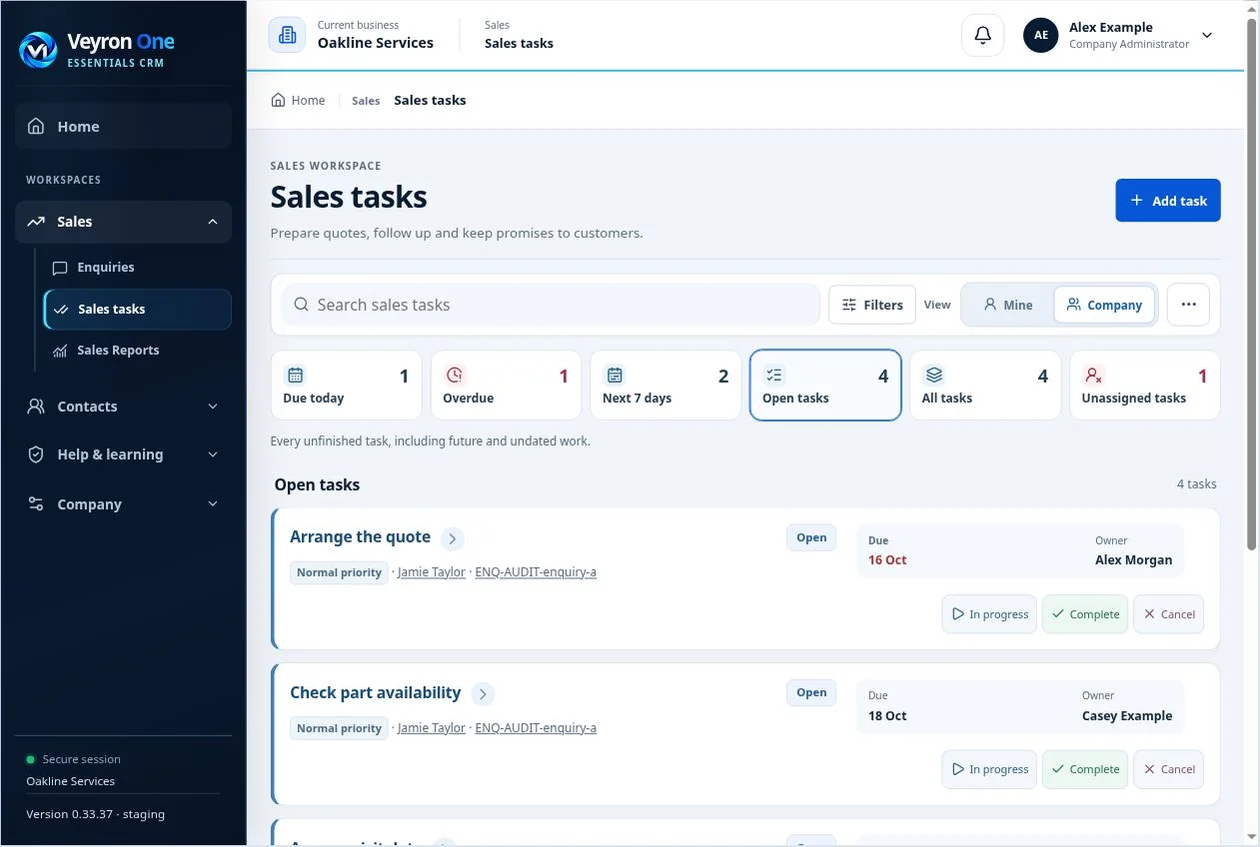
4. Update the record after contact.
Record the relevant outcome, complete the task when the action is done and decide whether another task is needed. Update the enquiry stage to reflect the actual position. Completing a call does not automatically mean that the customer has accepted a quote.
More detail
If the enquiry is lost or no longer active, record the outcome clearly. If it reopens, review the previous context before agreeing a new action.
5. Review the exceptions.
Build a short routine around overdue work, tasks due today, new enquiries needing a response and unassigned work. Open the relevant record before deciding the next step. Use reports as a prompt to investigate rather than assuming that every old enquiry is overdue in the same way.
More detail
For example, an enquiry awaiting a customer decision and a task overdue for your team are different conditions. Keeping the distinction clear makes the review more useful.
Put the routine into practice.
Start with a few fictional enquiries and make sure a colleague can understand who owns each one and what happens next. Then apply the agreed process to real customer requests with suitable access.
More detail
Explore customer and enquiry management, see the actual screens or start with free Essentials. Professional adds connected quote and work records when you need to carry the same journey further.
Put your next step in One.
Essentials includes one licence. Professional tools require the relevant plan and permissions.